AI deep research usually hands you 3,000 words you won't read, with citations nobody checks, and runs the most expensive model for the whole job. So I built an open-source skill for Claude Code and Codex that searches three providers, labels every claim, and delivers a short brief with a separate evidence file.
Key takeaway
Pay for judgement once: let the expensive model scope, challenge and write, let cheap models search, and let a System One classifier do the sorting at a thousandth of the price.
If you've ever run AI "deep research" before a pitch, a meeting or an interview, you'll know the shape of what comes back: 3,000 words you won't read, with citations that people rarely check.
Run badly, it's pure slop. It might take 15 minutes to produce (good for you), but it takes the person on the receiving end far longer to read and understand (not good for them). And most of the time it runs the most expensive AI model for the whole job, including the part where it sorts search results into piles.
So I built a research skill for Claude Code and Codex called Concise Deep Research. It can also be used in Claude Cowork, ChatGPT and any other AI tool that reads the open agent-skill format. It's open source, MIT licensed, and the whole thing is on GitHub at github.com/futureformed/concise-deep-research.
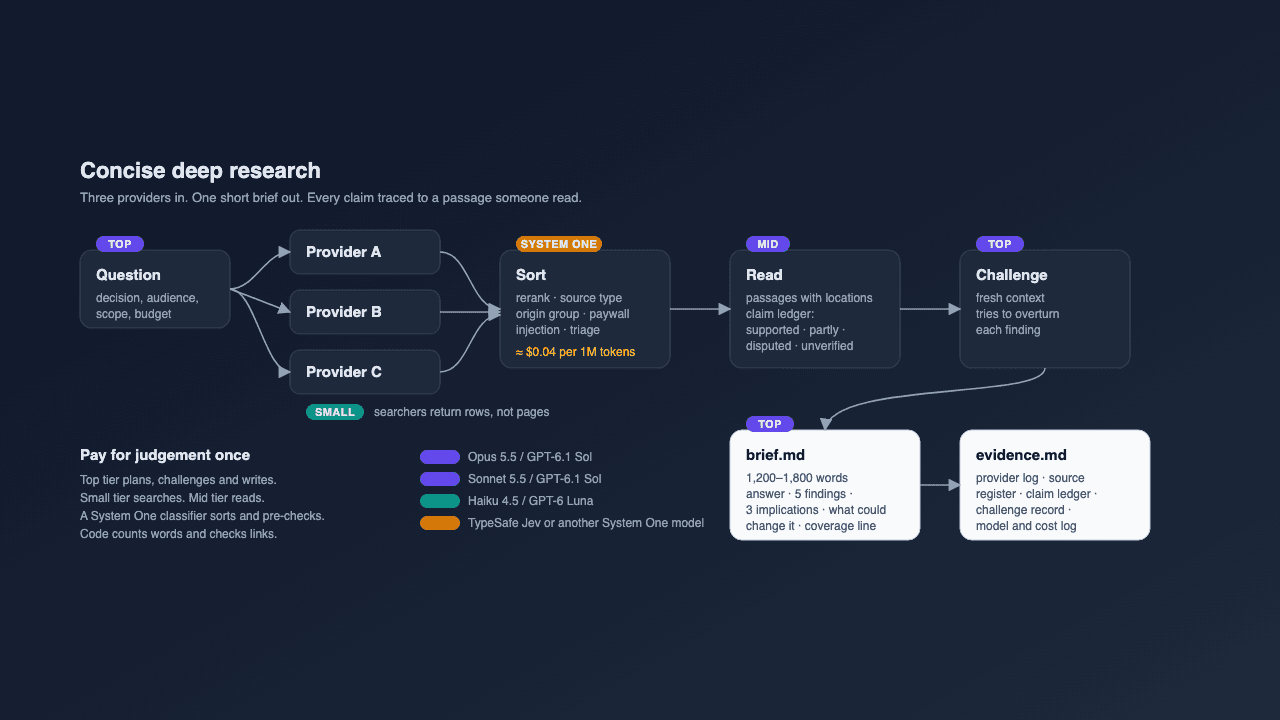
The five steps, and which tier of model runs each one
What it does
It searches through at least three separate search providers (Exa, Tavily and Brave, for example), reads the sources it cites, and labels every claim as supported, partly supported, disputed or unverified. If three articles are quoting the same press release, it counts them as one source, not three. If a page is paywalled, it says so rather than pretending it read it.
You get a brief of 1,200 to 1,800 words and a separate evidence file showing what was read, what wasn't, and where the evidence is thin. Each finding carries enough of its evidence that you can judge it without opening the evidence file. Half the length of a typical deep research report, with the receipts attached. The brief opens with the answer, then up to five findings, up to three things to do about it, and only the uncertainties that could change your decision.
Before it hands anything over, a second pass tries to knock the findings down. It looks for counter-evidence, checks whether two sources disagree because they measured different things, and marks anything it can't settle. That pass is the part most research tools skip, and it's the part that stops you walking into a meeting with a confident wrong answer.
Where the money goes
The cost part is pleasing. The expensive model does three jobs: scope the question, try to knock down the findings, and write the brief. Those are the jobs where judgement earns its price.
Cheap models run the searches. They come back with a table of what they found, never the pages themselves, so the expensive model isn't re-reading thirty web pages every time it thinks.
The sorting goes somewhere cheaper still. Is this result relevant? Is this a press release or a paper? Does this passage actually support the claim? Those questions go to a System One model. These are classifier models like TypeSafe's Jev or Cloudflare's new Clef. They don't write anything. You give them a passage and a question with a fixed set of answers, and they pick one and tell you how sure they are, at roughly a thousandth of the price of a chat model. Four cents per million tokens. For a whole research run, that's the cost of a text message.
The rule I've landed on: pay for judgement once. Everything that isn't judgement runs cheap or free.
Try it for nothing
Four of the search providers it supports work without an API key for light use, so you can try it before you spend a penny. The repo lists eight providers with sign-up links, free allowances and the one-line commands to connect each one to Claude Code or Codex. Installing the skill itself is two commands in Claude Code, or one with the skills installer for anything else.
A couple of things to be straight about. It needs a real run on a real question to judge research quality, and the prices in the docs will drift (fair warning). The method is all written up in the repo, including why each rule is there, so you can argue with it.
If you're not totally comfortable with GitHub repos, API keys and the like, drop me a note. Knowing how to use them will boost your AI capability massively, and it's less work than it looks.
What I'd like back
If you run it on something real, tell me what it got wrong. That's the feedback that makes it better. And if you want help getting research like this working inside your business, get in touch for a chat.
Related reading
This post sits with our Build work.
This piece was written by Liam D. at Futureformed. If it sparked a thought, we’d be happy to continue the conversation.
Get in touchMore from the journal
gStep: build it, ship it, then find out if anyone cares
The file formats that make AI cheaper and greener
Starting with AI, or stuck? Try the new AI Check
The five-minute AI check: what it tells you, and what it doesn't
Teach your AI that sometimes less is more.
Prompting Path: A Couch to 5K for AI
The AI Skill Gap Nobody Is Training For
You Are Never Going to Be Done Learning AI
You Don't Always Need the Biggest AI Model
How My Son and I Built a World Cup Tracker From Scratch
We Built a Mac App That Switches the AI Model Inside Claude Code and Codex
The AI Nightmares We Should Actually Be Having
We Built a Live Dashboard of Every AI Tool We Use, Here Is Why
Using Claude Cowork Efficiently in 2026
How We Built This: The Futureformed Website
AI Wattch: Seeing the Energy Cost of Your Prompts
The Hidden Cost of AI Agents
GreenPT: Sustainable AI That Doesn't Cost the Earth
AI Loyalty is Business Risk
Can't justify the compute? Give it the boot!
Breaking up from ChatGPT (it's not hard to do)
The Rise of the AI Orchestrator
The Hidden Dividend of AI: Giving Your People Their Time Back
AI Isn't a Tool. It's Your Next Operating System.
AI education is vital, but it doesn't need to be complicated
Shadow AI is already in your business. The question is what you do next.
AI isn't failing your business. Your change management is.
The first question I ask every client, and it's never about AI
AI transparency: This article was written by Liam D. The analysis, views, and conclusions are his own.