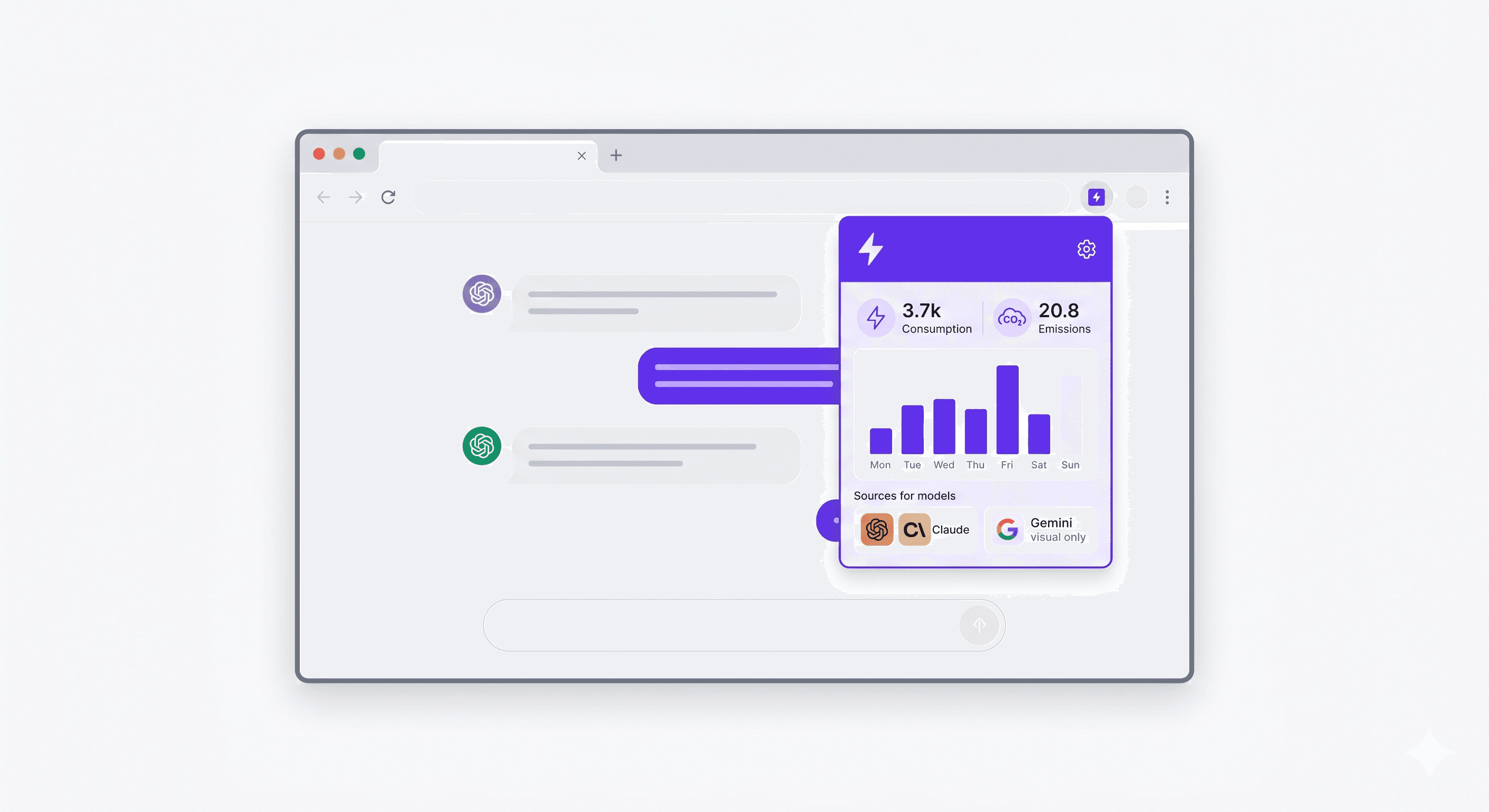
Most of us have no idea how much energy our AI usage consumes. AI Wattch is a browser extension that makes that invisible impact visible, in real time, without sending your data anywhere. It is a small tool with a genuinely useful nudge built in.
Key takeaway
AI Wattch translates your prompting habits into real energy and carbon data, helping individuals and organisations understand that responsible AI use starts at the level of the individual prompt.
We talk a lot about the environmental cost of AI at the infrastructure level: data centres, GPU farms, cooling systems. But there is another layer that gets far less attention, and it is one we each have direct control over.
Every prompt you send uses energy. A short, well-scoped request uses a small amount. A vague, sprawling one that produces a mediocre answer (and requires several follow-ups to fix) uses considerably more. That inefficiency is invisible to most users, and invisible problems tend not to get solved.
What AI Wattch actually does
AI Wattch is a browser extension built by Antarctica and IT Climate Ed. It sits quietly in the background while you use ChatGPT, Claude, or Gemini, and tracks the energy and carbon impact of your sessions in real time. Using something called the One-Token Methodology, it estimates compute intensity based on real-world model efficiency data and translates your activity into figures you can actually understand: energy used, CO2 emitted, and efficiency across sessions.
Crucially, it does all of this locally. Nothing is sent off your device. Your conversations remain private.
It is about awareness, not guilt
The framing from the team behind AI Wattch is worth noting. This is not a tool designed to make you feel bad about using AI. It is designed to make the invisible visible, which is a different thing entirely.
Once you can see that a vague prompt costs significantly more than a precise one (and often produces worse output), the incentive to improve your prompting habits becomes obvious. Better prompts save energy and get better results. That is a rare case where the environmentally conscious choice is also just the smarter one.
Why this matters at an organisational level
The technology sector is on course to represent around 8% of global emissions. Individual prompts are small, but organisations running AI at scale across hundreds of users start to accumulate meaningful compute waste, particularly if nobody has thought about prompt quality or model selection.
Tools like AI Wattch point to something we think about a lot at Futureformed: responsible AI use is not just a governance or compliance question. It starts with the habits of individual users. If your teams are prompting inefficiently, that is both an environmental issue and a cost and quality issue.
Worth installing
AI Wattch is free, private, and gives you a genuinely useful window into something most AI users have never thought about. If you are working with clients or colleagues on sustainable AI adoption, it is a good conversation starter too.
You can find it on the Chrome Web Store. If you are interested in how responsible AI fits into a broader transformation or adoption strategy, feel free to get in touch or book a discovery call.
Related reading
This post sits with our Responsible AI work.
This piece was written by Liam D. at Futureformed. If it sparked a thought, we’d be happy to continue the conversation.
Get in touchMore from the journal
The five-minute AI check: what it tells you, and what it doesn't
Teach your AI that sometimes less is more.
Prompting Path: A Couch to 5K for AI
The AI Skill Gap Nobody Is Training For
You Are Never Going to Be Done Learning AI
You Don't Always Need the Biggest AI Model
How My Son and I Built a World Cup Tracker From Scratch
We Built a Mac App That Switches the AI Model Inside Claude Code and Codex
The AI Nightmares We Should Actually Be Having
We Built a Live Dashboard of Every AI Tool We Use, Here Is Why
Using Claude Cowork Efficiently in 2026
How We Built This: The Futureformed Website
The Hidden Cost of AI Agents
GreenPT: Sustainable AI That Doesn't Cost the Earth
AI Loyalty is Business Risk
Can't justify the compute? Give it the boot!
Breaking up from ChatGPT (it's not hard to do)
The Rise of the AI Orchestrator
The Hidden Dividend of AI: Giving Your People Their Time Back
AI Isn't a Tool. It's Your Next Operating System.
AI education is vital, but it doesn't need to be complicated
Shadow AI is already in your business. The question is what you do next.
AI isn't failing your business. Your change management is.
The first question I ask every client, and it's never about AI
AI transparency: AI disclosure: this post was written by a human who immediately installed AI Wattch after reading about it and is now slightly more careful about vague prompts.