AI Loyalty is Business Risk
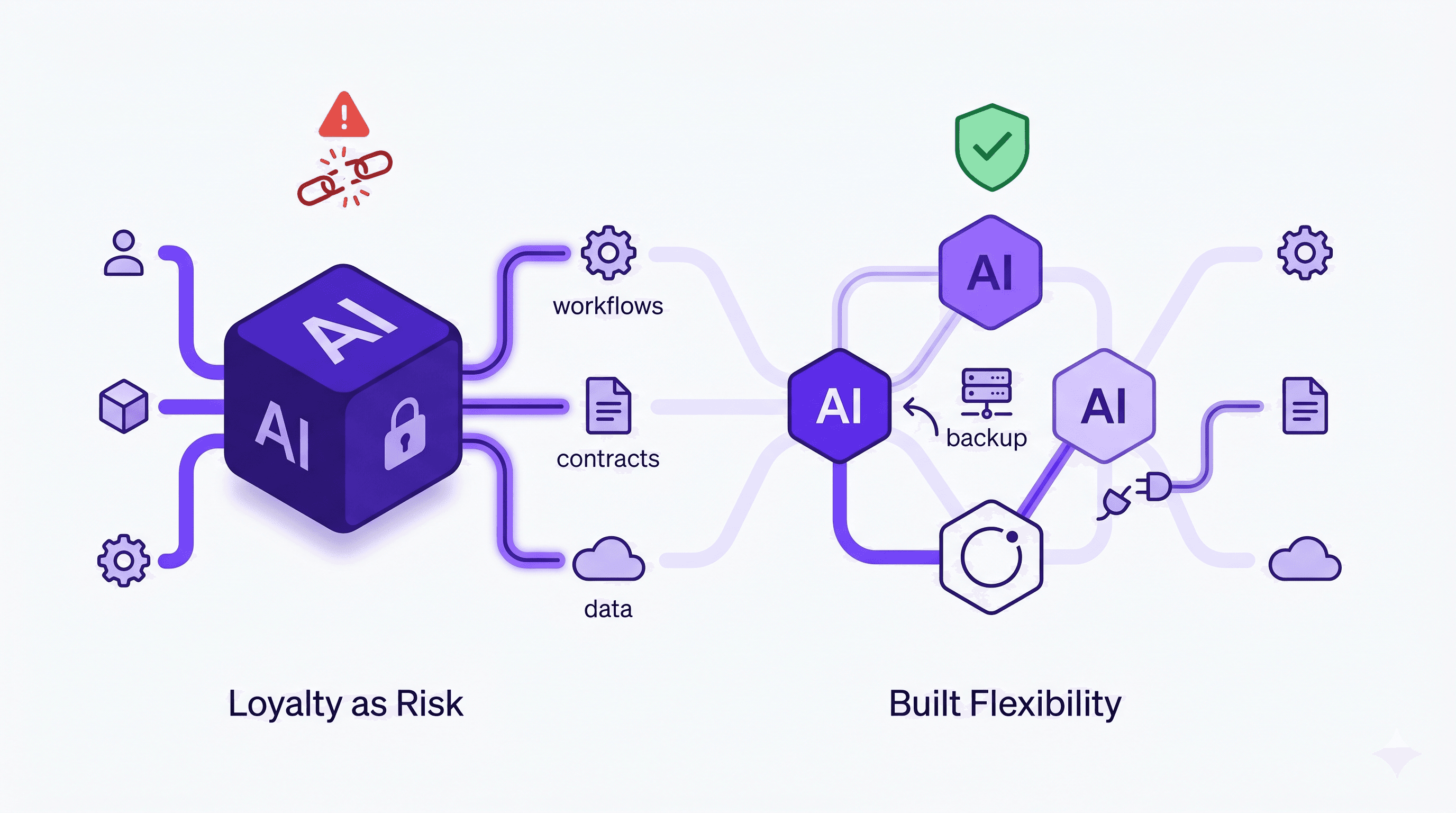
Most businesses have a continuity plan for power outages, key people leaving, and server failures. But how many have a plan for the day their preferred AI provider goes down, hikes prices, or changes direction? That gap is becoming a real problem.
Key takeaway
Loyalty to a single AI provider is a business continuity risk. Build flexibility into your AI stack now, with documented workflows, alternative providers, and contingency plans in place before you need them.
Most businesses have a continuity plan. You plan for power outages, for key people leaving, for servers catching fire. But how many organisations have a plan for the day their preferred AI provider goes down, hikes its prices, or simply changes direction in a way that doesn't suit them?
The provider isn't loyal to you
Earlier this year, we saw a mass exodus from one major AI provider to another. The reasons were political and values-based. But the knock-on effect was instructive: the destination platform's servers were overloaded. People who had been using it reliably for months suddenly couldn't access the work they'd built. Projects, workflows, and automations were effectively frozen.
The lesson isn't to avoid any particular provider. The lesson is that loyalty to a single AI provider is a business continuity risk.
No rewards for sticking around
There are no loyalty programmes in the AI space. No price breaks for long-term commitment. No preferential treatment for being an early adopter.
What you do get, if you stay with one provider without alternatives in place, is exposure. If that provider changes their pricing structure, you're forced to review the cost of doing AI-supported business which is a hassle no-one wants. If their service degrades, you have to rush into a review of alternatives and workarounds. If they make a decision you disagree with, commercially or otherwise, switching becomes painful and disruptive.
The same risk you already understand
Think about how your business handles other single points of failure. You back up your data. You cross-train staff so a key person taking two weeks off doesn't grind operations to a halt. You have secondary suppliers for critical components.
AI tooling should sit in the same category. The more your workflows depend on a specific tool, the more important it is to have an alternative ready.
Energy prices are rising and geopolitical uncertainty is real. AI providers are not immune to any of it, in fact, they're particularly vulnerable. Infrastructure costs affect pricing, compute capacity affects availability. A business with no plan B for its AI stack is making an assumption that nothing will change. That assumption has already been proven wrong.
What a good plan actually looks like
Vendor resilience for AI isn't complicated in principle. A few things make a real difference.
First, document your workflows. Agents, prompts, custom configurations: these are often just files. If they live only inside one provider's system, you've created a dependency that didn't need to exist. Back them up to your own storage and treat them like any other business asset.
Second, maintain access to at least one alternative provider via API. The major providers all offer API access. If your current provider becomes unavailable or unaffordable, you should be able to redirect your workflows without a significant rebuild.
Third, consider a local model for critical tasks. 'Open-weight' models have become impressively capable, with improvements occurring on a weekly basis (the online AI communities are so excited by the progress). Running a model locally removes most dependencies on external infrastructure. It also has benefits for privacy and energy use, but that's a topic for another post.
Fourth, run regular risk assessments of your AI service contracts and pricing structures. Know what would trigger a switch before you're forced into one.
If you're building agentic systems, think in layers
Hard-coding against a specific model or provider means any change involves a rebuild. Building in an abstraction layer, so your system can swap out the underlying model without touching the rest of the architecture, is the engineering equivalent of designing an engine that can be replaced without dismantling the entire car.
Given how fast the AI landscape moves, this is just sound practice.
The bottom line
The businesses that navigate the next few years of AI development well will be the ones that treat AI tooling like any other critical infrastructure: with redundancy, documentation, and contingency plans in place before they're needed.
You're not rewarded for your loyalty to an AI provider. Build flexibility in now, while it's a considered choice rather than a crisis response.
If you want help mapping your current AI dependencies and building a resilience strategy, we're happy to have that conversation. Get in touch or book a discovery call.
This piece was written by Liam D. at Futureformed. If it sparked a thought, we’d be happy to continue the conversation.
Get in touchMore from the journal
Teach your AI that sometimes less is more.
Prompting Path: A Couch to 5K for AI
The AI Skill Gap Nobody Is Training For
You Are Never Going to Be Done Learning AI
You Don't Always Need the Biggest AI Model
How My Son and I Built a World Cup Tracker From Scratch
We Built a Mac App That Switches the AI Model Inside Claude Code and Codex
The AI Nightmares We Should Actually Be Having
We Built a Live Dashboard of Every AI Tool We Use, Here Is Why
Using Claude Cowork Efficiently in 2026
How We Built This: The Futureformed Website
AI Wattch: Seeing the Energy Cost of Your Prompts
The Hidden Cost of AI Agents
GreenPT: Sustainable AI That Doesn't Cost the Earth
Can't justify the compute? Give it the boot!
Breaking up from ChatGPT (it's not hard to do)
The Rise of the AI Orchestrator
The Hidden Dividend of AI: Giving Your People Their Time Back
AI Isn't a Tool. It's Your Next Operating System.
AI education is vital, but it doesn't need to be complicated
Shadow AI is already in your business. The question is what you do next.
AI isn't failing your business. Your change management is.
The first question I ask every client — and it's never about AI
AI transparency: AI disclosure: this post is human-crafted. The argument is Liam's, the examples are real, and no AI decided what to be anxious about.