The Hidden Cost of AI Agents
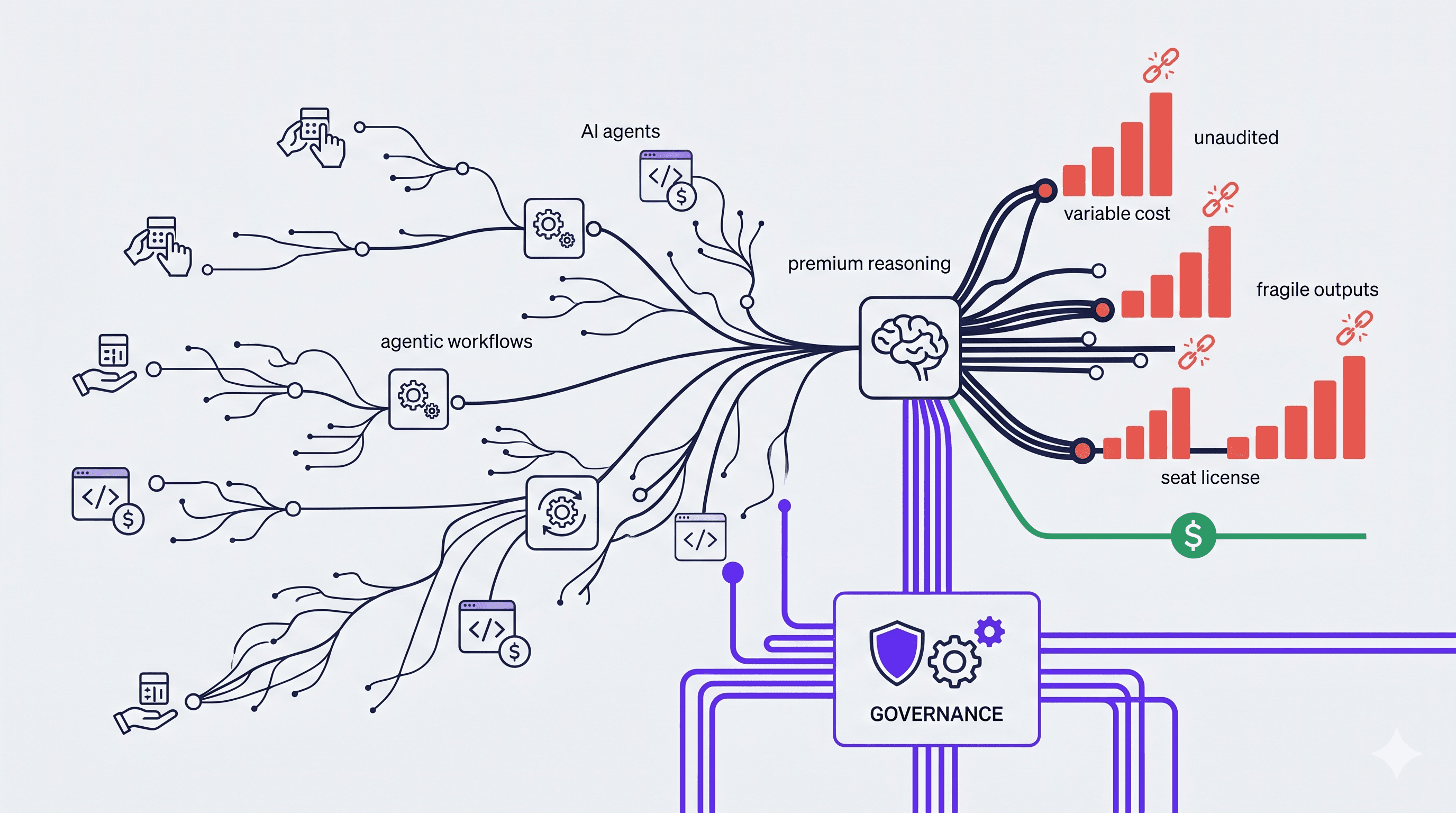
AI chatbots were the first budget line most organisations noticed. Agents will be the next, and this one will be harder to manage. When agentic workflows spread across a business, cost stops being a fixed subscription and becomes something you have to actively govern.
Key takeaway
AI agents introduce a new variable cost layer that organisations need to govern deliberately. Without clear rules on which workflows can use premium reasoning and autonomous task execution, agent sprawl becomes an expensive and hard-to-reverse problem.
The next AI cost shock for most organisations will not come from chatbots. It will come from agents.
Specifically, it will come from employees using agents to build things: scripts, dashboards, internal tools, automated workflows, prototypes, and in some cases other agents. The AI community is very excited about all of this (understandably so), but the excitement tends to outpace any serious thinking about what it costs.
From seat licences to something messier
The enterprise AI market is already shifting away from simple per-seat pricing. What you increasingly see instead is a baseline seat plus credits, premium request tiers, token-based coding consumption, and pay-as-you-go agent usage. That is a fundamentally different commercial model and it changes the question organisations need to be asking.
It is no longer just 'how many seats do we need?' It becomes 'which workflows should be allowed to consume premium reasoning, long context windows, autonomous retries, and coding agents?' That is a harder question, and most organisations do not yet have a process for answering it.
Agents have their own cost profile
A standard chat interaction is relatively cheap. An agent doing multi-step autonomous work, calling tools, retrying failed actions, and maintaining context across a long session is not. The cost per task can be an order of magnitude higher, and unlike a seat licence it does not sit still.
When one person uses an agent occasionally, the bill is manageable. When a hundred people across an organisation are experimenting with agentic workflows, each building their own automations and scripts, the cumulative spend can move very quickly, and in ways that are genuinely hard to attribute or forecast.
The sprawl problem
This is where it gets interesting, and not in a good way.
When coding agents and workflow builders become broadly accessible, you get proliferation. Analysts build dashboards. Operations teams build automations. Product managers spin up internal tools. Some of that is genuinely valuable. A lot of it is what you might call expensive AI theatre: frontier models summarising stale CRM data, generating reports nobody reads, and producing commentary that a basic rule-based workflow could have handled for a fraction of the cost.
Each of these tools is fragile to maintain but cheap enough to recreate, so the sprawl continues. Before long you have a portfolio of agent-built outputs that nobody owns, nobody has audited, and that collectively represent a meaningful and growing line of expenditure.
This needs governance, not just monitoring
The instinct in most organisations is to monitor costs after the fact. That is not enough here. By the time the bill arrives, the sprawl has already happened and unwinding it is painful.
What is needed is governance up front: clear decisions about which teams can deploy agents, which tasks justify premium model usage, and what a validated, maintainable output actually looks like. That is not about slowing people down. It is about making sure the investment produces something durable rather than a collection of fragile automations that nobody can explain in six months.
The organisations that handle this well will not necessarily be the ones generating the most agent-built software. They will be the ones that have thought carefully about which software deserves to exist, which agents are authorised to create it, and what each output genuinely costs to run and maintain.
What this means in practice
If your organisation is starting to see agentic tools show up across teams, now is the right time to get ahead of the cost question. That means understanding how your AI providers are pricing agent usage, building some governance around which workflows can access premium capabilities, and creating visibility into what is being built and what it is costing.
It does not need to be heavy-handed. But letting everyone run off and do their own thing, with no oversight and no accountability for spend, is a decision you will end up revisiting.
If you would like to talk through how to approach AI cost governance in your organisation, get in touch or book a discovery call. We are happy to have that conversation.
This piece was written by Liam D. at Futureformed. If it sparked a thought, we’d be happy to continue the conversation.
Get in touchMore from the journal
Teach your AI that sometimes less is more.
Prompting Path: A Couch to 5K for AI
The AI Skill Gap Nobody Is Training For
You Are Never Going to Be Done Learning AI
You Don't Always Need the Biggest AI Model
How My Son and I Built a World Cup Tracker From Scratch
We Built a Mac App That Switches the AI Model Inside Claude Code and Codex
The AI Nightmares We Should Actually Be Having
We Built a Live Dashboard of Every AI Tool We Use, Here Is Why
Using Claude Cowork Efficiently in 2026
How We Built This: The Futureformed Website
AI Wattch: Seeing the Energy Cost of Your Prompts
GreenPT: Sustainable AI That Doesn't Cost the Earth
AI Loyalty is Business Risk
Can't justify the compute? Give it the boot!
Breaking up from ChatGPT (it's not hard to do)
The Rise of the AI Orchestrator
The Hidden Dividend of AI: Giving Your People Their Time Back
AI Isn't a Tool. It's Your Next Operating System.
AI education is vital, but it doesn't need to be complicated
Shadow AI is already in your business. The question is what you do next.
AI isn't failing your business. Your change management is.
The first question I ask every client — and it's never about AI
AI transparency: AI disclosure: this post is human-crafted. The opinions on agent sprawl are Liam's own, formed from watching organisations discover their AI bill is larger than expected.